
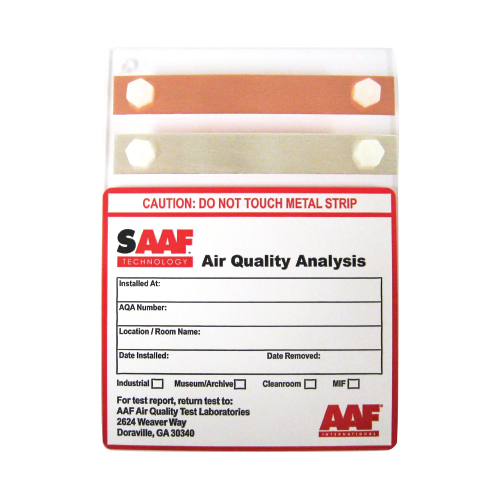
SAAF™ Reactivity Monitoring Coupons (RMC)

SAAF™ Reactivity Monitoring Coupons (RMC)

Product Overview

SAAF Reactivity Monitoring Coupons (RMCs) are used to measure environmental corrosivity levels by exposing them to the environment and analysing the resulting corrosion film. This process provides insights into the condition of protected environments, sensitive materials, and mechanical equipment.

Key Features

Environmentally Reactivity Assessment: Quantifies environmental reactivity according to ISA-71.04-2013 and related standards

Gas Ty pe Identification: Identifies various gas types, including sulphur compounds, chlorine compounds, compounds that form oxide films, and unknowns

Investigative Tool: Evaluates gas-phase filter performance

Typical Applications

Commercial Buildings
Data Centers
Food and Beverage
Healthcare
Hospitality
Microelectronics
Pulp & Paper
Refineries
Schools and Universities
Waste Management
Waste Water Treatment

Protecting Your Investment

Corrosion due to air reactivity can have costly consequences. In refining, pulp and paper mills, tyre manufacturing, and other process industries, the most significant consequence of electronic equipment corrosion and failure is downtime and lost production. In other industries, corrosion of server components means data centre downtime. Transactions stop, software applications for logistics cannot run, and data cannot be stored. For areas using compressors, reactive air can lead to more frequent maintenance schedules, process downtime, and eventually shortened compressor life.


SAAF Reactivity Monitoring Coupons provide information on average air reactivity over 30 days. This data helps clients evaluate area or room conditions in relation to air reactivity, and take any needed action to protect their electronics, equipment and processes.


Data Interpretation and Reporting

The SAAF Laboratory produces an application-specific report to summarise the data. This report provides photographs of new coupons and the exposed coupons for visual reference. It summarises the resulting environment classification, total corrosion formed on the coupons during installation, and individual corrosion film information, to differentiate between types of contaminants.

Comparing Data to Applicable Industry Standards

Industry standards exist for the protection of legacy electronics in process control rooms (ISA 71.04-1985), and for ROHS-compliant electronics used in control rooms, data centres, tyre manufacturing facilities, and other areas (ASHRAE TC 9.9 Guideline & ISA 71.04-2013). Compressor performance in archives and museums has also been correlated to reactivity monitoring results. Data from SAAFShield Technology can be directly related to these standards to evaluate the condition of spaces housing critical electronics, compressors or archival materials.

Measuring Environmental Reactivity

RMCs determine environment reactivity through exposure in the environment and subsequent lab analysis. This technology is used to investigate the condition of control rooms or other protected environments housing electronic equipment in industrial facilities such as pulp and paper mills, petrochemical refineries, and chemical plants. RMCs are also used to investigate the condition of facilities storing sensitive materials such as museums and archives, data centers, and microelectronic production or storage areas. Additionally, mechanical equipment like compressors can be affected by reactive gases in the air and can be evaluated with RMCs. Various standards and classification schemes are in existence which correlate corrosion film amounts to reactivity classifications.

Where to Use Reactivity Monitoring Coupons (RMCs)

Typical on-site test locations for RMCs include protected or critical spaces near critical electronic equipment or sensitive materials, upstream and downstream of gas-phase filters, and outdoor air intakes.  In addition to quantifying the reactivity of a particular environment, RMCs can be used as investigative tools to gauge the performance of gas-phase filter systems with respect to removal of gas types and the media replacement condition.

เราใช้คุกกี้เพื่อพัฒนาประสิทธิภาพ และประสบการณ์ที่ดีในการใช้เว็บไซต์ของคุณ คุณสามารถศึกษารายละเอียดได้ที่ นโยบายความเป็นส่วนตัว และสามารถจัดการความเป็นส่วนตัวเองได้ของคุณได้เองโดยคลิกที่ ตั้งค่า

Privacy Preferences

คุณสามารถเลือกการตั้งค่าคุกกี้โดยเปิด/ปิด คุกกี้ในแต่ละประเภทได้ตามความต้องการ ยกเว้น คุกกี้ที่จำเป็น

อนุญาติทั้งหมด
Manage Consent Preferences
  • คุกกี้ที่จำเป็น
    Always Active

    ประเภทของคุกกี้มีความจำเป็นสำหรับการทำงานของเว็บไซต์ เพื่อให้คุณสามารถใช้ได้อย่างเป็นปกติ และเข้าชมเว็บไซต์ คุณไม่สามารถปิดการทำงานของคุกกี้นี้ในระบบเว็บไซต์ของเราได้

  • คุกกี้เพื่อการวิเคราะห์

    คุกกี้ประเภทนี้จะทำการเก็บข้อมูลการใช้งานเว็บไซต์ของคุณ เพื่อเป็นประโยชน์ในการวัดผล ปรับปรุง และพัฒนาประสบการณ์ที่ดีในการใช้งานเว็บไซต์ ถ้าหากท่านไม่ยินยอมให้เราใช้คุกกี้นี้ เราจะไม่สามารถวัดผล ปรังปรุงและพัฒนาเว็บไซต์ได้

บันทึก